Women domestic workers in India form part of the “unorganised sector,” keeping them out of the various benefits and securities that the workers in the “organised sector” have access to. However, the Sexual Harassment of Women and Workplace (Prevention, Prohibition and Redressal), Act 2013 (SHW Act) is an exception, as it includes women domestic workers in its ambit and provides a redressal mechanism for them. The SHW Act provides for the creation of Local Committees (LCs) at the district level for the prevention and redressal of complaints of sexual harassment.
To ensure that the redressal mechanism is accessible, it calls for designating Nodal Officers at the municipality/ward level to receive complaints of sexual harassment. These Nodal Officers are meant to bridge the gap between workers in the unorganised sector and LCs by decentralising the complaint-filing system. However, their appointment at the district level in Delhi has hindered decentralisation, making justice inaccessible to many such working women. Amidst this, women domestic workers in Delhi have mobilised themselves, demanding the appointment of Nodal Officers at the ward level in their districts.
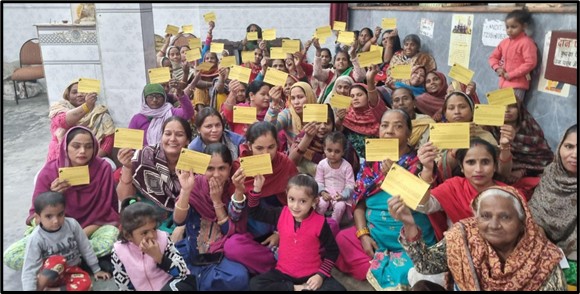
Women domestic workers, with their demand cards for the appointment of Nodal Officers.
“How can women like us access justice under the SHW Act when the Local Committee sits 20 kilometres away, and the Nodal Officers, who should be in every ward, are also stationed there?” asks Meena, a domestic worker from Gopalpur Basti in North Delhi, associated with the Martha Farrell Foundation (MFF). At a community meeting, Meena questioned the system of filing complaints under the SHW Act. She cannot afford to lose a day's wage or pay for transportation just to file a complaint. Like Meena, many other domestic workers have questioned the SHW Act, which promised protection, but whose implementation has made justice seem like a costly, faraway, and inaccessible dream. Taking matters into their hands, these women domestic workers have organised a campaign to advocate for the appointment of Nodal Officers in every ward/municipality.
Bridging the gap between LCs and women domestic workers
The SHW Act has been in force for over a decade now. Drawing inspiration from the Constitution of India and the Convention on Elimination of All Forms of Discrimination (CEDAW), to which India is a signatory, the law aims to provide a safe, secure and enabling environment to every woman employee, puts this responsibility on the employer, and lays down a statutory redressal mechanism. To make it inclusive of women working in the unorganised sector , the law takes a broad definition of “workplace” to include dwelling places or a house, and “workers” to include women domestic workers in its ambit.
The law operationalises the spirit of safe workplaces, particularly for women working in the unorganised sector, through the following institutional mechanisms:
While the LCs are meant to act as an institution to prevent and redress complaints of sexual harassment, the Nodal Officers aim to decentralise the redressal mechanism system to ensure easier access to justice, particularly for women domestic workers, who otherwise face significant barriers to filing complaints, such as the loss of daily wage and incurred travel expenses. The appointment of Nodal Officers, thus, is critical, as they act as a bridge between women domestic workers and LCs, being a first point of contact between workers and the LCs, especially in cases where the LCs are situated far away from workers and their place of work.
However, the ground reality is that this crucial bridge is broken. An analysis of data sourced through Right To Information (RTI) applications filed by MFF to Delhi’s 11 districts revealed that in 8 districts , Sub-Divisional Magistrates (SDMs) have been designated as Nodal Officers, while in the remaining 3 districts , either Administrative Department Officers or Tehsildars hold the position. In contrast, in Punjab, Nodal Officers have been designated at both the district and block levels in all districts, and in Uttar Pradesh, a few districts have designated Nodal Officers at both levels.
The appointment of a single Nodal Officer in Delhi for each district or zone (in case a district has multiple zones) centralises the complaint-filing system, thus defeating the objective of the SHW Act to make LCs more accessible to women working in the unorganised sector. This inaccessibility is reinforced by a lack of information, including the name and contact information, about the Nodal Officers.
The power of collective action
Since its inception in 2015, MFF has been working on the issue of gender-based violence and mobilising women around the issue of workplace safety. Under the #MainBhi programme, the organisation has mobilised women domestic workers from various communities of Delhi to advocate for the effective implementation of the SHW Act.
It is important to emphasise here that community mobilisation for community-led campaigns is critical because when challenging an entire system or ideology, the power of a collective is always greater than the power of individuals. Such campaigns bind the community together to initiate dialogue around issues which affect them and take action collectively to improve the overall well-being of the community. As an example of such a campaign, Mahila Abhivrudhi Mattu Samrakshana Samsthe (MASS) started a movement against the Devadasi system in Karnataka. Formed and led by former Devadasi women themselves, MASS has mobilised over 3,000 women across northern Karnataka to challenge the exploitative system, demanding strict enforcement of the Devadasi (Prohibition of Dedication) Act and access to government rehabilitation schemes.
Women domestic workers in Delhi and Gurugram, like the Devadasi women in Karnataka, decided to organise and come together. Due to the inaction by the District Officers to designate Nodal Officers, women domestic workers associated with MFF launched a demand campaign in late 2024. Women domestic workers, after discussion amongst themselves, prepared a set of demands to be submitted to the District Magistrate of their respective districts. The key demand was the appointment of Nodal Officers in every ward or municipality, as per the SHW Act.
This demand comes from the real-life challenges experienced by the WDWs in filing complaints. Many women shared their struggles of traveling long distances to reach the Local Committee, losing a day's wages, and often finding officials unavailable when they finally arrived. These real-life difficulties highlighted the urgent need for appointing Nodal Officers at the ward level in their districts.
Pehalkars (women domestic worker leaders) organised meetings with fellow workers, discussed their challenges, and gathered support for the campaign. A total of 1,030 women from South, South-East, and North districts of Delhi, as well as Gurugram, signed demand cards and submitted them to the District Magistrates. They demanded accessibility to LCs through the appointment of Nodal Officers at the ward level, making it easier for women to report cases of sexual harassment and seek justice without unnecessary hardships. This campaign illustrated the power of collective action, with women domestic workers coming together to demand their rights and push for a more accessible and fair justice system.
The Supreme Court’s observations
The Supreme Court has repeatedly highlighted the poor implementation of the SHW Act. In Aureliano Fernandes v. State of Goa (2023), the Court observed that there were serious lapses in the enforcement of the Act, even after a decade of its implementation. It further said that women were reluctant to report cases of sexual harassment as there is uncertainty about whom to approach under the Act for redressal of their grievance.
Reinforcing this, in Inclusion Foundation v. Union of India (2023), the Court directed District Officers to appoint Nodal Officers in every ward or municipality, in line with the SHW Act, and upload a district-wise chart of their contact details on the district’s website. However, none of Delhi’s 11 districts have complied with this directive, leaving the complaint-filing process inaccessible for women in the unorganised sector, particularly women domestic workers.
Way forward
Every day, millions of women domestic workers in Delhi leave their homes to earn a living, often as co-earners or even sole earners for their families. For them, domestic work is not merely an extension of household responsibilities - it is their livelihood. However, their work takes place in private homes, where they are isolated, lack written contracts, minimum wages, and social security, making them highly vulnerable to exploitation, sexual harassment, and violence.
The SHW Act is one of the few national laws that explicitly recognises the labour of women domestic workers, offering them an institutional mechanism for redressal. Yet, its effectiveness is undermined by poor implementation, lack of awareness, and the absence of a decentralised complaint-filing system.
Realising the importance of a decentralised complaint-filing system, in 2017, MFF, in partnership with the District Administration of South-East Delhi, piloted a model of designating Child Development Project Officers (CDPOs) as Nodal Officers. Though successful, this pilot was abandoned during the COVID-19 pandemic, and there has been an unwillingness to implement such a program again in any of the districts of Delhi, despite advocacy efforts by MFF. In 2024, as part of the process of developing a revised strategy for ensuring accessibility of LCs to women domestic workers, MFF facilitated the capacity building of Aanganwadi workers in North-East and East Delhi, proposing to make these trained Aanganwadi workers Nodal Officers. While the districts have declined to appoint them as Nodal Officers, they have been trained to be able to help women in filing complaints with their Local Committees.
As Meena and countless other domestic workers wait for justice, it is imperative that the authorities ensure that the system promised by the law is truly accessible. Otherwise, the bridge that was meant to connect them to justice will remain broken, leaving them stranded in a cycle of vulnerability and silence.


