It has been more than a year since I joined the social development sector.
I began as an intern in a newsroom, contributing to the elections team and reporting on issues from an outsider’s lens. In journalism classes, we are taught to maintain objectivity by staying "aloof" from our subjects.
I never fully understood what aloofness meant because, in practice, it often became a barrier to empathy. In the name of objectivity, people are reduced to leads, and stories become something to move on from quickly while searching for the next pitch.
Working at the Martha Farrell Foundation challenged this experience and understanding of mine in the media. The shift was not just professional, but deeply personal from “reporting on” to “listening to.” It required a gradual unlearning. What earlier was a reporting process which came from some research, pre-conceived notions, intended biases and my own expectations for a story now became a participatory process and an act where I listened more than I spoke.
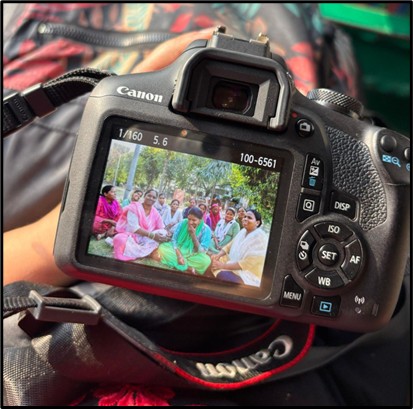
Last month, I listened to the stories of women domestic worker leaders and adolescent leaders, associated with the Foundation’s #MainBhi and Kadam Badhate Chalo programme. The interactions were filled with a sense of solidarity and trust between the women and myself. That experience felt different than what I did or observed in reporting. For the first time, I was not a complete stranger barging into someone’s home and asking them a bunch of intimidating questions. This time I was a very small part of their journey, yet not quite an insider. I knew fragments of their lives, something I had heard from the programmes’ team, or read in the publications, but nothing more than that.
In the development sector, the phrase "stories of change," is used quite often. Many claim this change as their impact. Before joining the sector, I used to question: is the impact ever really someone else’s? Can it belong to anyone other than the people who live it? After joining the sector, the answer, I realised, is still no.
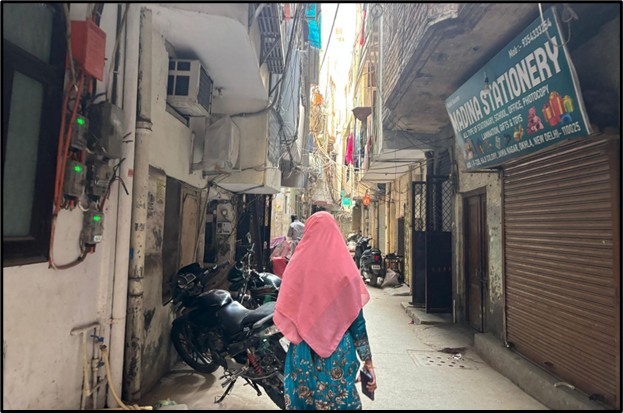
Daraksha showing the way to her home in Haji Colony.
And yet, conversations with the Pehelkars helped me see how organisations like the Martha Farrell Foundation contribute not by creating change, but by providing platforms, support systems, and enabling environments where change can flourish. By starting those difficult conversations on issues like gender, violence, menstruation, workplace safety, rights, and dignity among others. This is where I also unlearned that non-profits are no institutions with magic wands that can vanish deeply entrenched socio-economic and political challenges within existing systems in a jiffy. Social change as I observed and spoke to the Pehelkars requires dedicated intervention, which can be supported by non-profits along with the support of local authorities and other relevant government stakeholders, who are willing to enable that change and consistently work with and for the communities.
Through my journey at the Foundation, I realised the importance of this direct, dedicated, and consistent intervention. However, while exploring the sector, I also discovered its technocratisation. I also observed how platforms that are supposed to bridge the gap between the communities and the development they wish to see.
With a jargonsome language, conferences with lack of representation on the very issue being discussed, and funders with limited sensitivity towards issues they fund, especially as sensitive as gender-based violence, I realised the challenges and the impact co-exist. Somewhere around the lines of a tight budget but a strong vision, non profits function.
Before going to the field and understanding the experiences of the Pehelkars, I carried an imagined structure of how the conversations would unfold and what I would write. But once I was there, all of that fell apart. My objectives shifted. My methods changed. I had gone in thinking: Impact is in the number of women the Pehelkar collectivised, or within the number of cases they have solved. However, after having a few interactions, I started questioning myself, asking: Is number the only impact?
I met and listened to Usha, for whom impact lies in collectivising 100 women domestic workers in her community in Delhi’s Nandlal Basti. Something that once seemed impossible and is now her reality - something she was able to achieve. I spoke with Veronica, who did not define impact by her title as a Pehelkar, but by her first act of resistance against an abusive employer. I met Guddi, who now questions the police without fear when justice is delayed. I met Rinku, whose family blooms with pride when they see her in videos and stories documented. I met Nasreen, who has grown more fearless than ever. I met Selvi, for whom fixing salaries, leaves, and working hours for many women in her community is an impact. I met Shashikala, for whom knowledge of the law and the ability to demand a comprehensive one for all is a privilege she attained and an impact in itself. I met Rajni, who finds impact in simply occupying a space she can call her own, doing what she loves, through the Swabhiman Kendra. I met Anu, for whom securing a day off from her employer on Domestic Workers’ Day is an impact. I met Shobha, who sees impact in addressing cases of violence within her community. I met Daraksha, for whom learning to read and write and supporting women in her community is an impact. And I met Mohit, determined to take safety audit recommendations to local municipal authorities.
Each conversation shifted my understanding. It made me realise that impact lies within these small shifts.
As a communications professional, I often felt detached at times from these stories and experiences. However, through these interactions I realised that when a Pehelkar tells their story, they are not offering “content” for a booklet; they are reclaiming their identity, recalling their contributions and journey with a sense of pride and courage. As a storyteller, our role is not to “give them a voice.” They already have one. It is bold, resilient, and powerful.
Our role, instead, is to create spaces where voices like these are visible, heard, and valued so that when such experiences enter the public domain, they carry the weight they truly deserve.
There remains a persistent challenge in the sector: how do we measure impact? As if it is something that can be measured with a 'scale' or a 'weighing machine'!!! An excel sheet may capture how many people attended a training, but it cannot capture an internal shift the moment someone decides to speak up, to resist, to lead. The challenge lingers on the sector why only measurable outcomes are translated as impacts.
The conversations I had in the field as an outsider but not as a complete stranger, made me realise that impact measurement is best done while grounded in lived realities and perspectives of those whose lives are being impacted.
What does impact mean to them? What does change look like in their lives? What has worked, and what needs to evolve? These are the questions that matter. And these are the questions that should be asked from non-profits and not “how many women they have empowered”? Because ultimately, impact is not something we create, it is something people claim for themselves.


