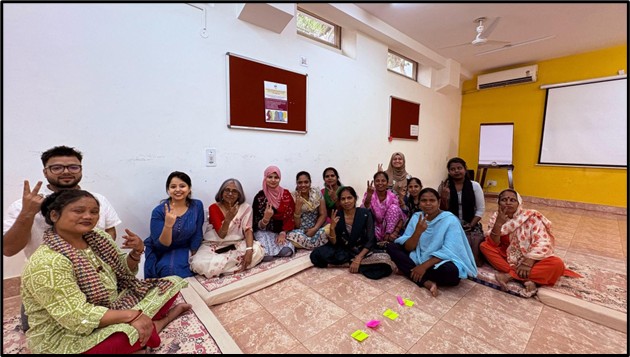
From the listening and sharing circle (Picture credits : Lalita Kumari )
On 24 April, 2026 a group of women working in the informal sector - most of them domestic workers in Delhi - who had been trained as community mediators by the Martha Farrell Foundation (MFF) - met in the office of the Foundation for a listening and sharing session on how big wars in faraway lands directly impact their lives and livelihood.
The conversation was organised in collaboration with Peacebuilder Forum India as part of a nationwide campaign on Indian Women’s Call for Global Peace that was flagged off at Gandhi Samadhi Rajghat on 17 July, 2026. Through animated, engaged, and powerful conversations, skillfully moderated by Samiksha Jha of MFF, the 12 women spoke candidly of how their lives and the kitchens were being turned upside down by the violent conflict between US, Israel, and Iran.
The kitchen was no longer a happy space where food was prepared for hungry school children and adults going out for work. The crisis of cooking gas cylinders following the outbreak of the war and the blockades in the straits of Hormuz had transformed their kitchens into a violent zone where fights were breaking out due to the anxiety and tension of how the next meal was going to be cooked.
Instead of the kitchen being a place where food is cooked with love and care it had emerged as a space of anxiety and frantic strategy around how a single cylinder could be made to last longer, who would take time out to negotiate for the next cylinder and when it was likely to come. It even boiled down to cutting down on the staples- a family member used to have four rotis would now get two - not because there was no wheat in the house but because the cylinder would finish if so many rotis were to be made.
A thriving black market industry was selling gas cylinders for Rs 5000/ and the “normal” cylinders were taking too long to deliver. The families of these women domestic workers had moved to the city in search of work and had no experience of how to handle chulhas (traditional earthen ovens). Families unused to cooking on chulhas were now being forced to use them – the smoke was exacerbating asthma in an already highly polluted city and was causing physical ailments. As domestic workers who had to report for work in the mornings and evenings cooking time was now also taking much longer in absence of the gas cylinder they were used to which meant arriving late at their workplaces. The women were even being forced to enter forested areas often in the dark to look for wood to cook the basic meals for sustenance. In this context they shared a horrific story where a woman was bitten by a venomous snake while she was looking for firewood in the wake of the gas cylinder crisis. They are not forest dwellers and are unused to signs and signals of approaching danger in these wooded areas.
They spoke of the irony of government rations filling their households but no fire to cook them. As one participant put it “we have so much wheat and rice lying around but are we expected to eat it raw?”
The war in the Middle East has also meant that the prices of essential commodities in general have gone up. They lacked the collective power to ask for a raise in salary to combat these rising expenses. One participant shared that she had carefully saved money to buy gold for her daughter’s marriage but now that was proving to be inadequate as gold prices had gone up due to the war in the Middle East. How, she asked, can I send my daughter to her married home without giving her something for her security in the form of gold, as is the tradition in this country.
The participants also highlighted how the war was impacting their mental health with this additional anxiety, tension, frustration about how to cook, when to cook and what to cook. Family quarrels were on the rise as also between neighbours. Cooperation was being replaced by competitiveness as everyone was trying to hoard fuel for their respective families in the days to come. As domestic workers they were also witnessing that though everyone was impacted by the war the well-off could afford alternatives like induction cookers while their struggle was constant.
The women also expressed their anxiety about the impact this was having on their children. They were being exposed to violent images of war, they felt that war literally entered into the kitchen and as one participant put it: more than ourselves we are concerned about the impact of violent wars and conflict on our children.
The participants shared their emotions following the outbreak of the West Asia war and the chaos it was unleashing thousands of miles away in their home and hearth. They identified their emotions as anger, frustration, sadness, helplessness and said if negotiations are being held during and after the war why could they not have been held before the actual war broke out since they felt there must have been enough signals that things were getting out of control.
In raising this question they were pointing to the importance of recognising early warning signs and engaging in conflict prevention work. The conversation highlighted all wars are a matter of global community concern given its ability to disrupt food and energy security in an interconnected world. It was also significant to note that if they were at the negotiating table the starting point of a peace framework would begin by a discussion around the future of their children.


