“Everyone should have the freedom to roam, irrespective of being a boy or a girl” says Mohit, who has been living in Tigri for the last ten years. He lives with his family consisting of his father, mother and elder sister. He has been engaged with the Kadam Badhate Chalo programme for the past few months. He recently finished class 12th and works at a food processing unit. Mohit gets four leaves a month; he uses one of these leaves to participate in the community meetings. Despite his work, Mohit enthusiastically enquires about the next meeting date so he can plan his leave accordingly.
Mohit heard about the programme after seeing his friend’s sister attend the meetings. He recalled seeing her participate in discussions, activities, and games, which made him curious. Today, Mohit feels that these sessions go beyond a single topic and support him to address the issues he sees around him.
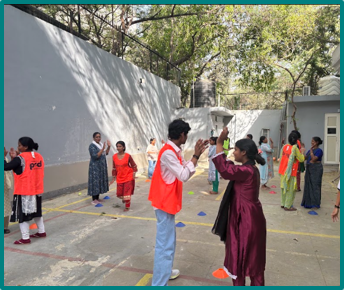
One of the first sessions Mohit remembered attending was on gender. He recalls that the facilitator placed a few objects in front of everyone and asked everyone about the gender associated with each object. As he answered the question, Mohit reached a realisation: most of the items associated with girls were pink. Why is this the case? This made him reflect on the gender roles expected of men and women. Why is it that men are told not to do household tasks but rather go outside and work?
“Can men not do household work? Can men not cook?”
Mohit recalls an instance when he was 16, his father who works as a daily labour got injured, and they needed support to sustain the household; as a result, Mohit started working. He would go to work after school, carrying a change of clothes in his bag, and reaching home late at night. Only after his father’s injury had improved and the exams were approaching did Mohit focus back on his education. Even today, Mohit feels the pressure of working and being productive. Sitting at home is frowned upon.
Outside his personal life, Mohit believes he has a crucial role to play in creating a safe space for women and girls. He believes that a lot of factors contribute towards creating unsafe conditions for women, and he wants to work towards addressing them.
“We have created a team for this. The team works together to ensure that people feel comfortable and free in the community. Irrespective of whether it is day time or night time. No one should think that now it’s evening or now it’s night and dark outside. Or some people would be standing on the corner of the street which makes passing by difficult. Everyone should have the freedom, irrespective of whether they are girl or boy” says Mohit.
One of the most empowering experiences for Mohit has been conducting a Participatory Safety Audit of his neighbourhood. The tool allowed Mohit to identify safe and unsafe areas, along with thinking of ways to increase safety in the locations. Mohit talks about the PSA map and shares that the unsafe areas in his locality are the reason that girls are unable to move freely. However, the tool has also provided Mohit with ways to demand change and that can be achieved together with the team:
“In future we will show this to the MLA of our locality. We will go in a group and use this map to explain everything. We will explain why all of these things are needed and the photos would act as proof and if we go in a group, they won’t be able to say no”
This tool has been powerful for Mohit, not just to speak with the MLA and demand improvements in the locality but also to know what changes are needed and hold the government accountable in the future.
As Mohit grows older, he wants to continue with his education through open college as he continues working. His mother, who once taunted him for sitting idle at home, now attends meetings with Mohit and encourages him to do well. And every month, without fail, Mohit takes one leave, not to rest but for the meeting.


