 Growing up in a village in Panipat district, Nitu learned the rules early. Girls stayed close to home. Girls kept quiet. Girls didn't play Kabaddi, didn't speak up at family meetings, didn't dream too loudly.
As the youngest of four siblings — three sisters and one brother — Nitu watched those rules play out every day. When her family sat down to make a decision, only one voice mattered.
"Previously, our voices held no weight in our family dynamics because we are three sisters and only one brother. Whenever a discussion happened at home, questions were directed only towards my brother. But when I started addressing gender-based discrimination within my family, the dynamic began to shift."
"Whenever a discussion happened at home, questions were directed only towards my brother," she says. "Our voices held no weight."
For years, that felt normal. Then Nitu joined the KBC programme and everything she thought was "just the way things are" started to look a lot more like a choice someone else had made for her.
The moment it clicked was during a session called the Gender Relay, where adolescents unpack the different expectations placed on boys and girls: boys study, earn, go outside, decide. Girls stay home, do the housework, follow the rules. Nitu realized these weren't facts of life. They were roles and roles can be questioned.
She took that realization straight home. She started asking her family why her brother's opinion came first. It didn't go smoothly at first years of habit don't unravel in one conversation. But she kept having the conversation. Slowly, her family began listening. Today, Nitu and her sisters are part of the decisions that shape their own lives.
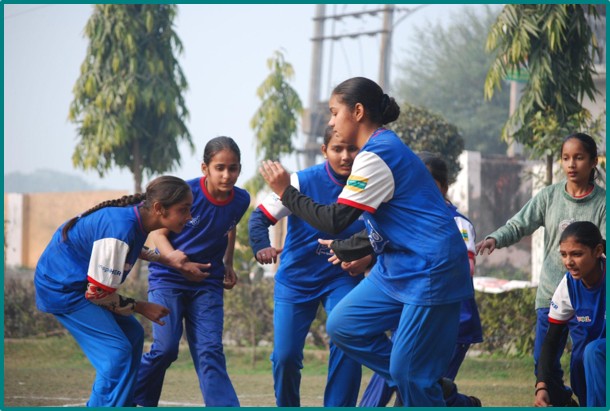
Once Nitu started seeing the invisible rules at home, she started seeing them everywhere — in who got to move freely through the village, who got to choose their own clothes, who got to play. So she picked up a Kabaddi ball. Girls weren't supposed to play in her village. She did anyway.
"If I could play Kabaddi within the confines of my own village," she says, "I could just as easily step out into the wider world and play in an open arena."
Nitu's confidence kept building. She joined a Participatory Safety Audit, walking the village with other young leaders to map out where girls felt unsafe — and why. Then came International Women's Day. Nitu stood in front of her parents, her neighbors, and the village Sarpanch, and presented what they'd found. This was the same girl who used to feel too shy to speak up in front of her own parents.
"That day," she says, "I stood before the entire village and spoke without fear."
Nitu has a clear-eyed take on gender-based violence: it doesn't start with the big, visible harms. It starts small; a restricted education, a limited choice, a closed door. Challenging those small things, she believes, is where real equality begins. And she's clear that boys have a part to play too, by respecting girls and backing that respect up with action. She's not the same girl who once accepted the rules without asking why.
“I feel proud to speak out and try to raise awareness."
Nitu is proof that change doesn't always start with a big moment. Sometimes it starts with one conversation and the courage to keep starting them.