“My brothers would put restrictions on me and wouldn’t let me leave home, and when I would tell this to my mother, she would scold me instead.”
Sumiya is a 13-year-old girl studying in 7th grade in a rural family of Panipat District, Haryana. Her father works as a farmer, and her mother manages the household; she lives with her three brothers. She had learnt to stay quiet, do what is expected of her and keep her thoughts to herself. Even at her home, Sumiya has learnt to stay inside and listen to her brothers without arguing. However, the threshold of her silence and tolerance changed with KBC.
In the multiple sessions held with Sumiya, she shares how the viewing of Dastak film (a nukkad natak video depicting different forms of violence) was the most memorable and impactful experience for her. Watching the film made Sumiya realise how women and girls have to face violence even before they are born and how it follows them throughout their lives. Such as boys throwing objects at girls simply for stepping outside. It showed young girls being manipulated, groomed and harmed by people they trusted. It gave a name and a shape to things she had sensed but never had words to describe.
Soon, she began talking. At home and in public places. Sumiya started talking about gender-based violence and gender based discrimination. She also started questioning why her brothers, who are slightly older than her, decide if Sumiya can step out of the home and where they go.
Sumiya started speaking with her mother about this, sharing with her how restrictions are a form of discrimination, and her mother understood. Sometime later, her mother had a conversation with her brothers and told them this needs to stop. Sumiya also began questioning why she is the only one doing household chores, and soon things started to change. Over time, her brother began doing household chores. And as he did, the family members understood that there is no reason for girls and boys to be treated differently. This also inspired her friends to join the programme, and they too are advocating for change in their communities.
“Previously, my mother used to make me do all the household chores; however, ever since I joined this programme and started discussing gender-based violence with my family and friends, a significant change has taken place within my family. Now, my brother also helps me with the housework and my parents have begun to understand that boys and girls are equal.”
The programme has enabled Sumiya to see her neighbourhoods in new ways. She notices how society prevents girls from going to school or completing their education. This was also visible with how Sumiya was discouraged from playing sports. In a village where girls are restricted from playing sports, the programme allowed Sumiya to play sports. At first, her family was hesitant with this, but then Sumiya’s mother spoke with her brothers and now she can play sports. Today Sumiya plays Kabadi.
She now notices how, when husbands drink alcohol, they become violent towards their wives and questions why only wives? This violence is not just physical but also financial. In many instances, Sumiya mentions that after marriage, the husbands take the money earned by their wives, leaving women financially dependent. Seeing these forms of violence has strengthened her to speak up.
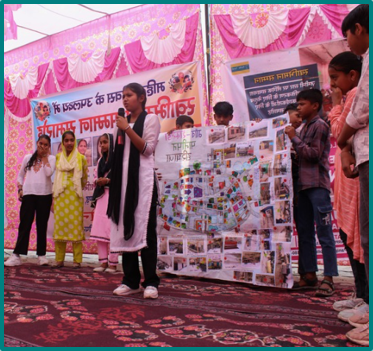
As one of the programme activities, Sumiya and adolescent leaders created a map of the village, marking spaces that felt safe and unsafe. And on 7th March, Sumiya stood on the stage, in front of the entire village and shared the factors that influence the safety of the village. Something Sumiya could not have imagined doing before. Sumiya and her friends shared different factors that have contributed towards the unsafety, including the water body that is dirty and polluted. It needs to be cleaned, they said on the stage, in front of the Village Sarpanch and Child Protection Officer.
“I spoke about safety in front of everyone. Earlier, I was not allowed to speak at home, that day I spoke in front of the entire village.” As Sumiya grows older, her ideas around equality evolve.


